
Quick answer: Slots use a Random Number Generator (RNG) that produces a new sequence of numbers every millisecond, determining each spin’s outcome independently. Paylines are the specific patterns across the reels where matching symbols must land to trigger a payout. Neither the machine nor the player can influence or predict when a spin is "due" — every spin is a fresh, independent event with the same odds as the last.
Key takeaways
- RNGs generate thousands of number sequences per second; the exact millisecond you press spin is what counts.
- Paylines can be straight, zig‑zag, V‑shaped or scattered across the reels — more active paylines increase your chance of a win but also raise the total bet.
- RTP (Return to Player) is a long‑run percentage calculated over millions of spins; it does not guarantee any single session result.
- A "due" win is a myth — the RNG has no memory of previous spins.
- Always check the game’s paytable and rules before playing, and set a budget you can afford to lose.
What it is and why it matters
If you have ever watched the reels spin and wondered whether the machine "remembers" your last loss or whether a big win is waiting just around the corner, you are not alone. Understanding how slots actually work helps you play with clearer expectations and keeps the experience fun rather than frustrating.
At the heart of every online slot is a Random Number Generator (RNG). This is a software algorithm that produces a continuous stream of numbers, typically between 0 and several billion, at a rate of thousands per second. When you hit the spin button, the slot freezes the RNG output at that exact millisecond and maps those numbers to the symbols on the reels. Because the RNG never stops, the moment you press spin is unique — the numbers it uses have never been used before and will never be used again in exactly the same way.
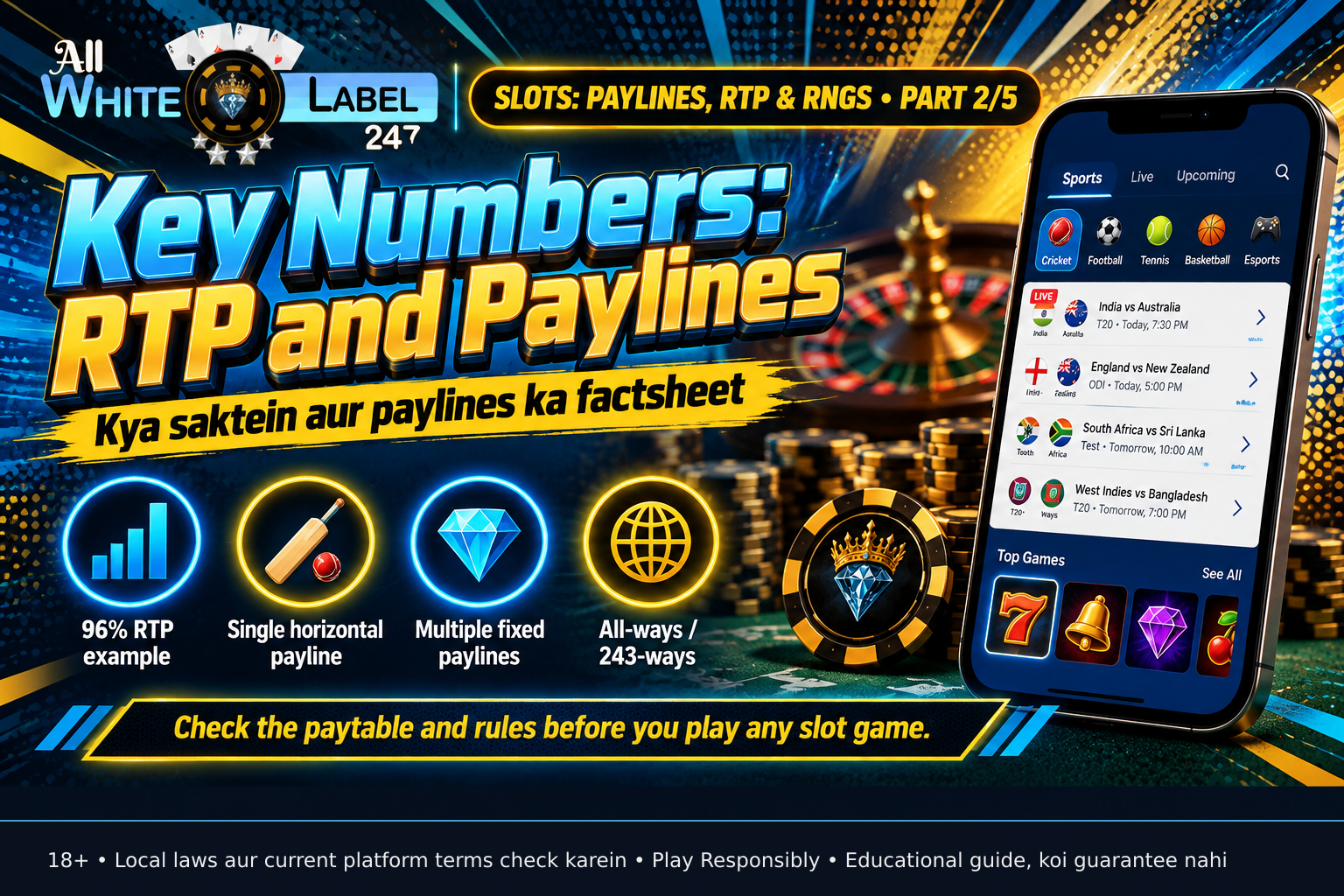
Paylines are the lines across the reels where matching symbols must land for you to receive a payout. Traditional slots had a single horizontal payline, but modern video slots can have dozens or even hundreds of paylines that run straight, diagonally, in zig‑zags, or in V‑shapes. Some games even pay for symbol clusters that appear anywhere on adjacent reels, regardless of a specific line.
Why does this matter? Because the number of active paylines you choose directly affects your total bet and your chance of hitting a winning combination. Activating more paylines costs more per spin but gives you more patterns to win on. Deactivating paylines lowers your cost but also reduces the ways you can win.
RTP (Return to Player) is another number you will see listed, usually as a percentage between 90% and 98%. It represents the amount of total money wagered on a game that is paid back to players over a very large number of spins — typically millions. For example, a slot with 96% RTP is expected to return ₹96 for every ₹100 wagered, but that return is spread across countless spins and many different players. In the short term — a single session or even a few hundred spins — the actual result can be far above or below that percentage.
The reason RTP matters is that it gives you a sense of the game’s long‑term payout behaviour, not a promise of what will happen in your session. A 96% RTP does not mean you will get 96% of your money back if you spin 100 times. It means that, over millions of spins across all players, the game will retain about 4% as the house edge.
The core mechanism: how a spin actually works
- RNG generates a number sequence continuously.
- You press spin — the game locks the current RNG value.
- Mapper translates that number into reel positions and symbol stops.
- Reels display the resulting symbols.
- Paylines evaluate whether any active line has matching symbols.
- Payout is awarded according to the game’s paytable for any winning combinations.
Because step 1 never stops, the exact millisecond you click spin determines the outcome. Two players pressing spin at different times will get different results, even on the same machine. This is why no spin is ever "due" — the RNG has no memory of past spins, and the odds reset with every single click.
Also read: Platform security for an online casino
Comparison: Payline types and their risk profile
| Payline type | Typical pattern | How it works | Risk / reward effect |
|---|---|---|---|
| Single horizontal | One line across the middle reels | Wins only when matching symbols land on that exact line | Lower cost, fewer ways to win |
| Multiple fixed | Several lines, often zig‑zag or V‑shaped | Wins on any active line; usually all lines are bet on automatically | Moderate cost, more winning patterns |
| All‑ways / 243‑ways | Symbols on adjacent reels pay left‑to‑right | Any matching symbols on consecutive reels trigger a win, regardless of position | Higher cost per spin, frequent small wins |
| Cluster pays | Groups of same symbols touching anywhere | Wins when a cluster of matching symbols forms, often with a meter or feature trigger | Variable cost, often includes bonus features |
Table: Common payline structures and how they change the way wins are triggered. The "risk / reward effect" column describes the general feel of the game — more paylines usually mean more frequent but smaller wins, while fewer paylines can mean bigger but less frequent payouts.
Myths about "due" spins and hot machines
One of the most persistent beliefs in slot play is that a machine is "due" for a win after a long dry spell, or that a machine that has just paid out will not pay out again soon. Neither of these is true.
The RNG does not track how long it has been since the last win, nor does it adjust its output based on recent payouts. Every spin is an independent event with the same probability as the last. A machine that has not paid a major prize in 100 spins has the exact same chance of paying on the 101st spin as it did on the first. Similarly, a machine that just awarded a jackpot is not "colder" — the next spin’s outcome is completely unrelated.
Believing in "due" spins can lead to chasing losses or spending more than planned in the hope that a win is imminent. Recognising that the RNG has no memory helps you treat each spin as a fresh, standalone event.

Also read: The DLS method in plain words
Common mistakes to avoid
- Thinking a spin is "due" — the RNG has no memory; every spin is independent.
- Playing with more paylines than you can afford — activate only as many as your budget allows.
- Relying on RTP to predict a single session — RTP is a long‑run average, not a short‑term guarantee.
- Chasing losses — believing a win is "just around the corner" often leads to betting more than you intended.
- Ignoring the paytable — each game has its own rules, symbol values and bonus features; reading them before you play prevents surprises.
Quick checklist: what to check before you spin
| What to check | Why it matters |
|---|---|
| RTP percentage | Gives a sense of long‑term payout behaviour, not a short‑term promise. |
| Number of active paylines | Determines your total bet and how many ways you can win. |
| Minimum and maximum bet limits | Ensures you stay within your budget. |
| Paytable and symbol values | Shows how much each combination pays and what triggers bonuses. |
| Volatility description (low, medium, high) | Indicates whether wins are frequent but small, or less frequent but larger. |
| Bonus feature rules | Explains free spins, multipliers, pick‑me rounds and any conditions. |
Brand mention
AllWhiteLabel247 provides white‑label iGaming platform solutions for operators in India and South Asia. If you are an operator looking to launch a casino or sportsbook, you can fill in your brand‑specific RTP ranges, payline configurations and bonus structures in the platform dashboard. Always verify the current terms and RTP figures on your official platform page, as these are set during integration and may vary by jurisdiction.
Call to action
If you are trying a new slot for the first time, take a moment to open the paytable, note the RTP and decide how many paylines you want to activate — then set a budget and stick to it. Remember: every spin is independent, and the only thing you can control is how much you wager and when you stop.
FAQ
1. What does RTP mean in a slot game? RTP stands for Return to Player. It is a percentage that shows how much of the total money wagered on a game is expected to be paid back to players over millions of spins. It is a long‑run average, not a guarantee for any single session.
2. Can a slot machine be "due" for a win after a losing streak? No. The Random Number Generator produces independent outcomes for every spin. The machine has no memory of previous results, so the odds reset with each click of the spin button.
3. Do more paylines increase my chance of winning? Activating more paylines does give you more patterns that can result in a win, but it also increases the total amount you bet per spin. Choose the number of paylines that fits your budget, not just the desire for more winning chances.
4. What is the difference between volatility and RTP? RTP is the long‑run percentage of money returned to players. Volatility (or variance) describes the risk profile: low‑volatility games pay smaller amounts more frequently, while high‑volatility games pay larger amounts less frequently. Both are set into the game’s maths, but they tell you different things.
5. How is the RNG outcome determined when I press spin? The RNG is constantly generating numbers. When you press spin, the game locks the number sequence that is active at that exact millisecond and maps it to reel positions. The moment you press spin is what determines the result — two players pressing spin at different times will get different outcomes.
6. Can I influence the result of a spin by timing my click or using a specific betting pattern? No. The RNG operates independently of player actions. The outcome is determined the instant the spin is initiated, and no betting pattern or timing trick can change the underlying maths.
7. What does "hit frequency" mean? Hit frequency is the percentage of spins that result in any kind of payout, even if that payout is smaller than the amount you bet. It is different from RTP, which measures the total amount returned over the long run.
8. Are online slots rigged? Licensed online slots use certified Random Number Generators that are regularly audited by independent testing labs. These RNGs ensure that every outcome is random and unbiased. Always play on platforms that hold valid licences and display their audit certificates.
9. What is a "cluster pay" slot? In cluster‑pay slots, a win is triggered when a group of matching symbols lands touching each other anywhere on the reels, rather than following a specific payline. These games often include a meter or feature that activates after certain cluster sizes are reached.
10. Does the time of day affect my chances of winning? No. The RNG operates continuously and does not change based on time, day, or any external factor. Your chances are the same whether you spin at 3 PM or 3 AM.
11. What should I do if I think I’m developing a gambling problem? If you feel your gambling is becoming difficult to control, set strict deposit limits, take regular breaks, and consider using self‑exclusion tools offered by your platform. You can also reach out to responsible‑gambling organisations for support.
12. Can I play slots for free without real money? Many platforms offer demo or "play‑for‑fun" modes that use virtual credits. These are useful for learning the game’s mechanics and paytable, but any winnings in demo mode are not real and cannot be withdrawn.
13. What is the house edge? The house edge is the mathematical advantage the casino holds over players, calculated as 100% minus the RTP. For example, a slot with 96% RTP has a 4% house edge, meaning the casino expects to retain ₹4 for every ₹100 wagered over the long run.
14. Are progressive jackpot slots different from regular slots? Progressive jackpot slots include a growing prize pool that increases with each bet placed across the network. A small portion of every wager contributes to the jackpot. The base game mechanics (RNG, paylines, RTP) are similar, but the chance of hitting the top jackpot is typically much lower than winning regular prizes.
15. How do I know if a slot game is fair? Look for games from reputable software providers that display certificates from independent testing agencies (such as eCOGRA, iTech Labs or GLI). These certificates verify that the RNG is fair and the game’s RTP matches the stated percentage. Playing on licensed platforms also adds a layer of oversight.
Sources
- Official casino software documentation — RNG and RTP mechanics
- Independent testing laboratory reports on slot game audits
- Game paytable and rules screens from popular video slots (publicly available)
- Industry explanations of payline structures and volatility models
Draft requires