

Quick answer: An operator choosing a white-label platform must decide whether the product is a sportsbook, where the house sets the odds and keeps the overround, or a betting exchange, where users match each other and the platform takes a commission. The exchange model shifts risk to players but demands higher liquidity and more sophisticated risk management. This article explains the mechanics, costs and operational differences so you can pick the model that fits your launch timeline and risk appetite.
Key takeaways
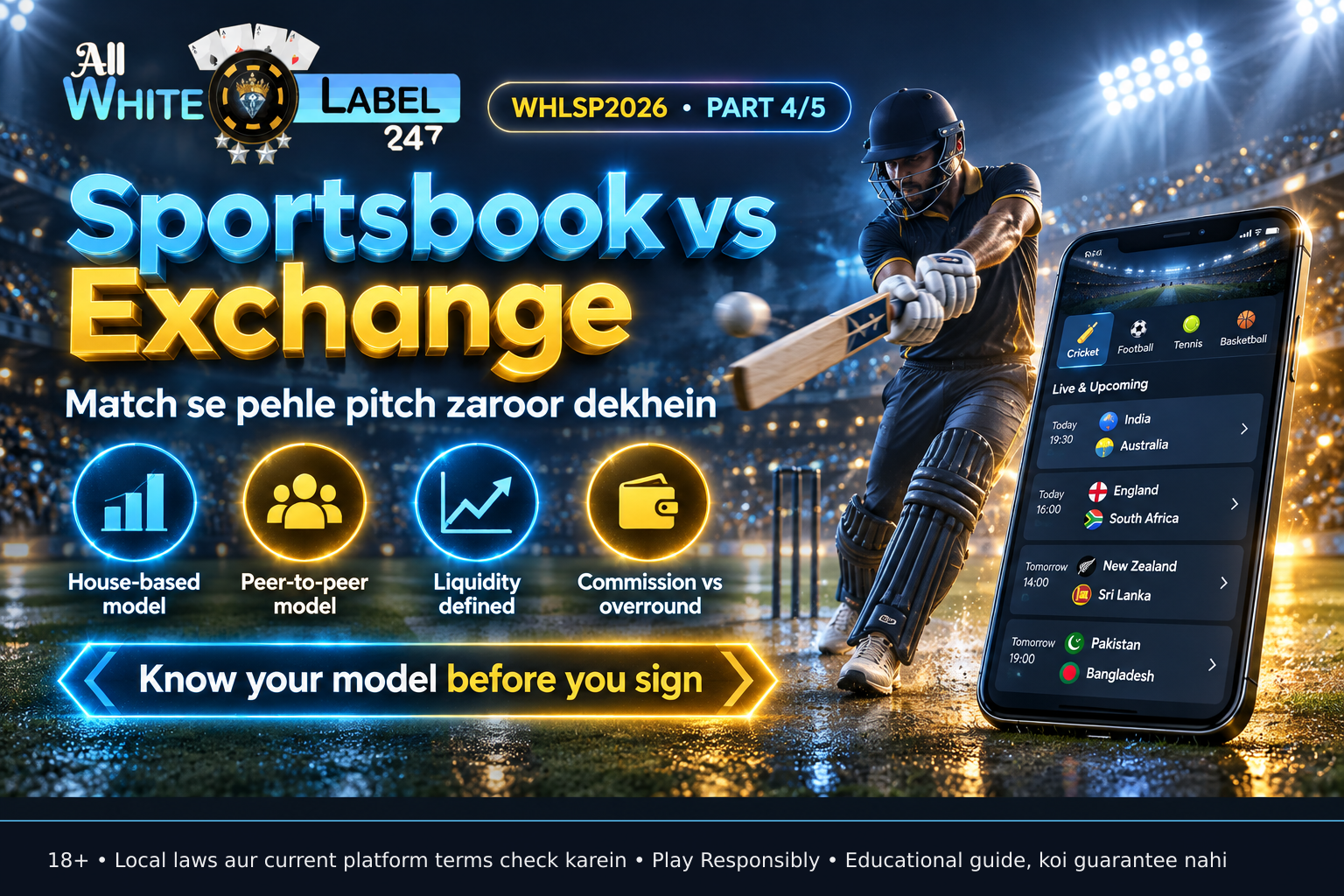
- A sportsbook is a house‑based model: the platform sets odds, collects the overround and carries the risk of imbalanced action.
- A betting exchange is a peer‑to‑peer marketplace: users back and lay outcomes, the platform takes a commission on net winnings, and liquidity determines how quickly bets match.
- Liquidity is the exchange’s biggest operational challenge; a sportsbook needs capital reserves but can price its own market.
- Commission structures differ: exchanges typically charge 2‑5% of net winnings, while sportsbooks embed the margin into the odds (usually 4‑6% overround).
- Risk management in a sportsbook relies on limiting stake sizes and adjusting odds; on an exchange, the platform must monitor position exposure and manage market‑making risk.
- White‑label turnkey solutions can launch either model in 4‑8 weeks; building a custom exchange adds 3‑6 months for liquidity engine development.
What it is and why it matters
You are at the stage of deciding the core product architecture for your iGaming venture. The choice between a sportsbook and a betting exchange affects every downstream decision: the technology stack you need, the capital you must reserve, the licensing narrative you present to partners, and the responsible‑gaming tools you must build. Getting this right before you sign a white‑label contract saves you from a costly pivot halfway through launch.
In a sportsbook, the platform acts as the bookmaker. It publishes odds, accepts bets from customers, and pays out winners from the losses of other customers (or from its own reserve). The built‑in margin—the overround or "vig"—is baked into the odds so that, over a large volume of bets, the house expects to retain a predictable percentage regardless of which outcomes occur. The operator sets the risk parameters: maximum stake sizes, exposure limits, and the ability to suspend markets if the balance shifts too far.
In a betting exchange, there is no house‑set odds. Instead, users post "back" bets (betting on an outcome to happen) and "lay" bets (betting against an outcome). When a back and a lay match at the same price, the exchange facilitates the bet and takes a commission, usually a fixed percentage of the net winnings. The platform does not care who wins or loses; it earns its fee from the volume of matched bets. Liquidity—the amount of money sitting at various price levels—is the exchange’s lifeblood. Without sufficient back-and-lay volume at competitive prices, users see delayed matches or prices that drift away from the market.
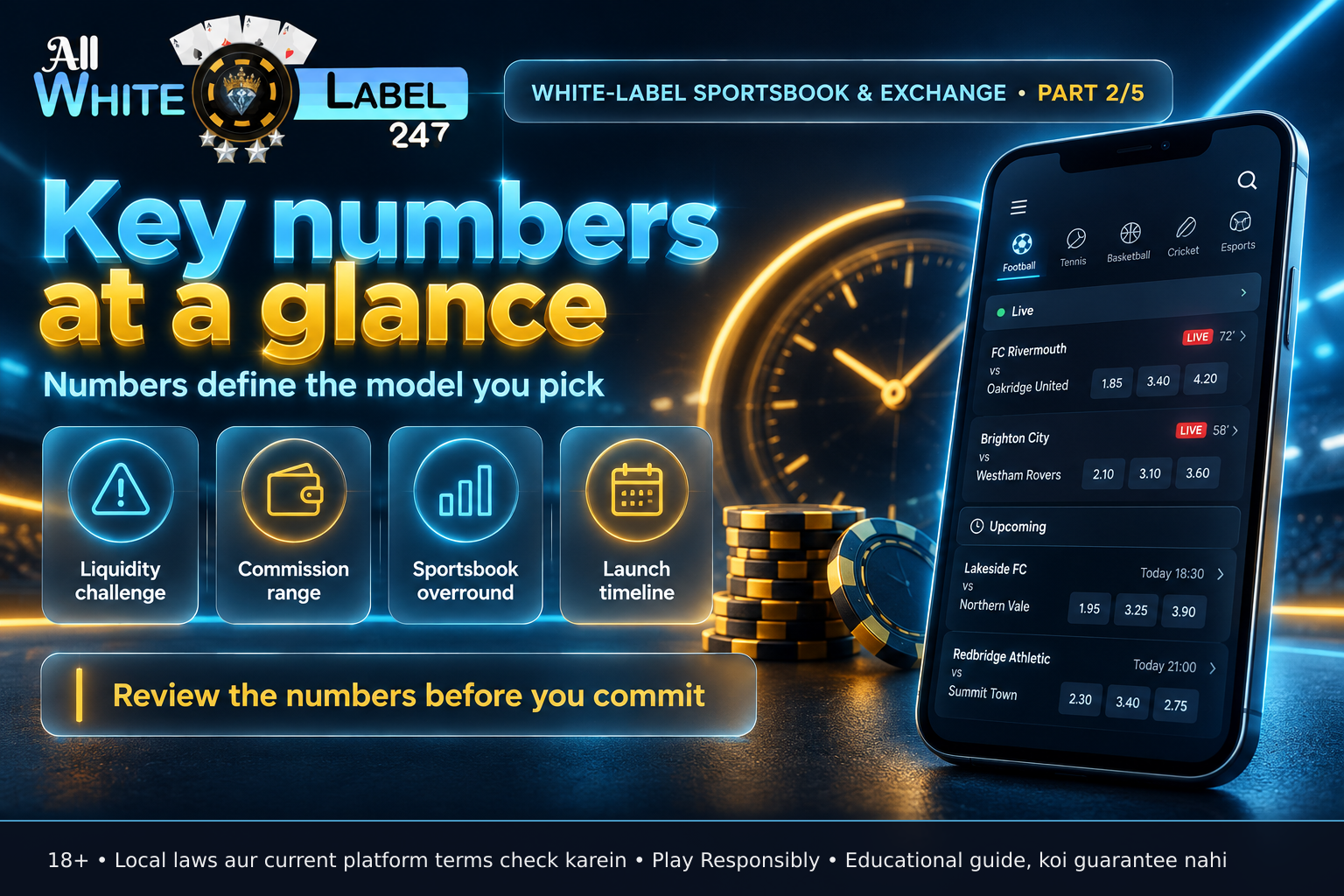
For an operator, the decision hinges on three practical pillars: liquidity, commission, and risk management. Liquidity determines whether your users can get bets matched instantly or wait in a queue. Commission structures affect your revenue share and your incentive to market the product. Risk management dictates how much capital you must set aside, how you handle large wins, and what fraud‑prevention measures you need.
Also read: AllWhiteLabel247: The Complete White Label Sports Betting Platform for Modern Gaming Businesses
Core checklist for operators
- Define your liquidity strategy – Will you rely on the white‑label provider’s existing user pool, or will you need to integrate a liquidity bridge to external exchanges? Ask the provider what average daily matched volume the package includes and what happens if your launch traffic exceeds that number.
- Compare commission models – Some white‑label packages bundle a flat‑rate commission (e.g., 2% of net winnings) into the licence fee; others charge a revenue‑share percentage on top of the base fee. Clarify whether the quoted rate is gross or net, and whether there are tiered reductions as volume grows.
- Assess risk‑management tools – For a sportsbook, check what staking limits, exposure caps and auto‑suspension features are included. For an exchange, ask how the platform monitors open positions, manages unmatched bets, and settles markets when the event concludes.
- Understand the technology stack – A sportsbook needs a odds‑compiling engine and a payment‑settlement workflow. An exchange requires a matching engine, order‑book persistence, and real‑time price updating. Ask the vendor for a technical specification sheet and confirm it matches your in‑house team’s capabilities.
- Plan the launch sequence – White‑label turnkey solutions typically take 4‑8 weeks from contract to live, assuming brand assets and basic compliance checks are ready. A custom exchange build adds 3‑6 months for the matching engine and liquidity onboarding. Map your marketing calendar against these timelines.
- Budget for ongoing operational costs – Beyond the white‑label licence fee, factor in server hosting, KYC/AML integration, support staff for peak hours, and compliance audits. These vary widely based on jurisdiction and transaction volume.
- Align responsible‑gaming features with your chosen model – Both models must offer deposit limits, self‑exclusion, and reality checks. On an exchange, you must also consider how to set limits on individual back/lay amounts and how to handle market‑void scenarios when users cancel bets.
Sportsbook vs exchange: a decision table
| Dimension | Sportsbook | Betting Exchange |
|---|---|---|
| Odds setting | Operator compiles and publishes odds; overround built into prices | Users set their own back/lay prices; platform matches at intersecting levels |
| Revenue source | Margin embedded in odds (typically 4‑6%); losing customer bets fund winners | Commission on net winnings (typically 2‑5%); volume‑dependent |
| Liquidity requirement | Operator provides the market; price is what the house offers | Depends on user‑generated supply and demand; deep order book needed for instant matches |
| Risk profile | House carries risk of imbalanced action; managed via stake limits and odds adjustment | Platform is neutral; risk is market‑making exposure and unmatched bet settlement |
| User experience | Fixed odds, instant bet placement, clear payout schedule | Users choose prices, may wait for match, see order‑book depth, cash‑out options often available |
| White‑launch timeline | 4‑8 weeks for turnkey package | 4‑8 weeks for basic matching engine; 3‑6 months additional for liquidity onboarding |
| Regulatory narrative | "We hold a licence to operate a bookmaking business" | "We provide a platform for peer‑to‑peer betting; users assume market risk" |
Table: How the two models compare across the dimensions an operator must weigh before signing a white‑label agreement. Figures (overround, commission rates, timelines) are typical ranges; always verify the specific contract you are offered.
Also read: White Label Ya Custom Betting Platform?
Liquidity: the exchange’s make‑or‑break factor
In a pure exchange model, if there is no one on the other side of your user’s bet, the bet does not match. This creates a poor user experience: the punter sees "waiting for liquidity" or the price drifts while they wait. White‑label providers address this in different ways:
- Internal liquidity pool – The provider brings its own existing users’ bets onto your brand. This is the quickest route to a functional exchange at launch, but you are dependent on the provider’s user base and may not have control over the price discovery mechanism.
- Liquidity bridge – Integration with a recognised exchange (e.g., a leading peer‑to‑peer platform) via API. This gives you immediate access to deep order books, but you pay a data‑feed or usage fee, and the user experience is mediated by the partner’s interface.
- Self‑generated liquidity – You attract your own users to post back and lay bets. This gives you full control but requires a marketing spend and a period of time—often months—before the order book is deep enough for comfortable betting.
Ask any prospective white‑label vendor: "What is the average daily matched volume included in the package, and what is the process if our launch campaign drives traffic above that threshold?" The answer will tell you whether you need to budget for a bridge or a self‑generated liquidity push.
Commission and revenue flow
The financial model is straightforward but often misunderstood.
- Sportsbook – The operator sets odds that include a margin. If the total amount staked on all outcomes is ₹100 and the overround is 5%, the operator expects to keep ₹5 regardless of result, paying out ₹95 to winners. The margin is not a "fee" charged to the user; it is simply the difference between the true probability and the offered odds.
- Exchange – The platform takes a percentage of the net amount the winning player receives. For example, if a user backs a result at odds of 3.0 and wins ₹300 (including stake), and the commission rate is 3%, the platform deducts ₹9, and the user receives ₹291. The losing player pays nothing extra; the commission is a charge on the winner only.
Some white‑label contracts quote a "revenue share" rather than a fixed commission. In that case, the operator receives a percentage of the platform’s gross commission income, after deducting taxes, chargebacks and refunds. Clarify whether the quoted share is gross or net, and whether there are minimum monthly guarantees or claw‑back clauses.
Risk management: house vs marketplace
Risk management looks very different depending on the model.
In a sportsbook, the primary risk is that too many customers bet on one outcome and the house must pay out more than it collects from losers. Operators mitigate this by:
- Setting maximum stake limits per customer and per market.
- Using algorithms that shorten odds on heavily backed outcomes and lengthen odds on under‑backed ones.
- Monitoring betting patterns for arbitrage or syndicate behaviour.
- Maintaining a reserve fund that can cover peak‑day payouts.
In a betting exchange, the platform is theoretically neutral—it does not set odds and does not profit from customer losses. However, the operator still faces operational risk:
- Unmatched bets – If an event is suspended or cancelled, how are open positions settled? The platform must have a clear rule set.
- Position exposure – Even though the house does not take the opposite side, large unbalanced books can affect the integrity of the market. Some exchanges employ market‑making algorithms to ensure a minimum level of depth.
- Fraud and bonus abuse – Because users can lay outcomes, there is a vector for "lay‑betting" with bonus funds or arbitrage across multiple bookmakers. KYC and position‑monitoring tools are essential.
Both models must incorporate responsible‑gaming tools. Deposit limits, loss limits, self‑exclusion timers and reality‑check pop‑ups are expected by regulators and by the player community. On an exchange, you may also need to allow users to set maximum back/lay stakes per market, and you must decide how to handle situations where a user’s position becomes liability‑heavy due to market movement.
Launch sequence: from contract to live
- Sign the white‑label agreement and provide brand assets (logo, colour palette, domain preferences).
- Submit KYC/AML compliance documents for the jurisdiction where you plan to operate. This is the single biggest delay point; have your legal team ready to produce corporate registrations, beneficial‑owner statements and financial‑source proofs.
- Choose your product model (sportsbook or exchange) and confirm the included features: odds compiler, wallet integration, payment methods, responsible‑gaming widgets.
- Integrate payment providers – UPI, net‑banking, wallets, and international cards. Test deposit and withdrawal cycles in a staging environment.
- Configure the matching engine or odds compiler – For an exchange, this includes setting commission rates, market depth parameters and settlement rules. For a sportsbook, this means defining the overround distribution and stake‑limit matrices.
- Run internal QA and pilot launches – Small groups of staff or beta users test bet placement, settlement, and customer‑support workflows.
- Go live – Flip the switch. Monitor the first 48‑72 hours closely for liquidity health (exchange) or bet‑settlement accuracy (sportsbook).
- Post‑launch optimisation – Adjust stake limits, tweak commission structures, add payment methods based on user feedback.
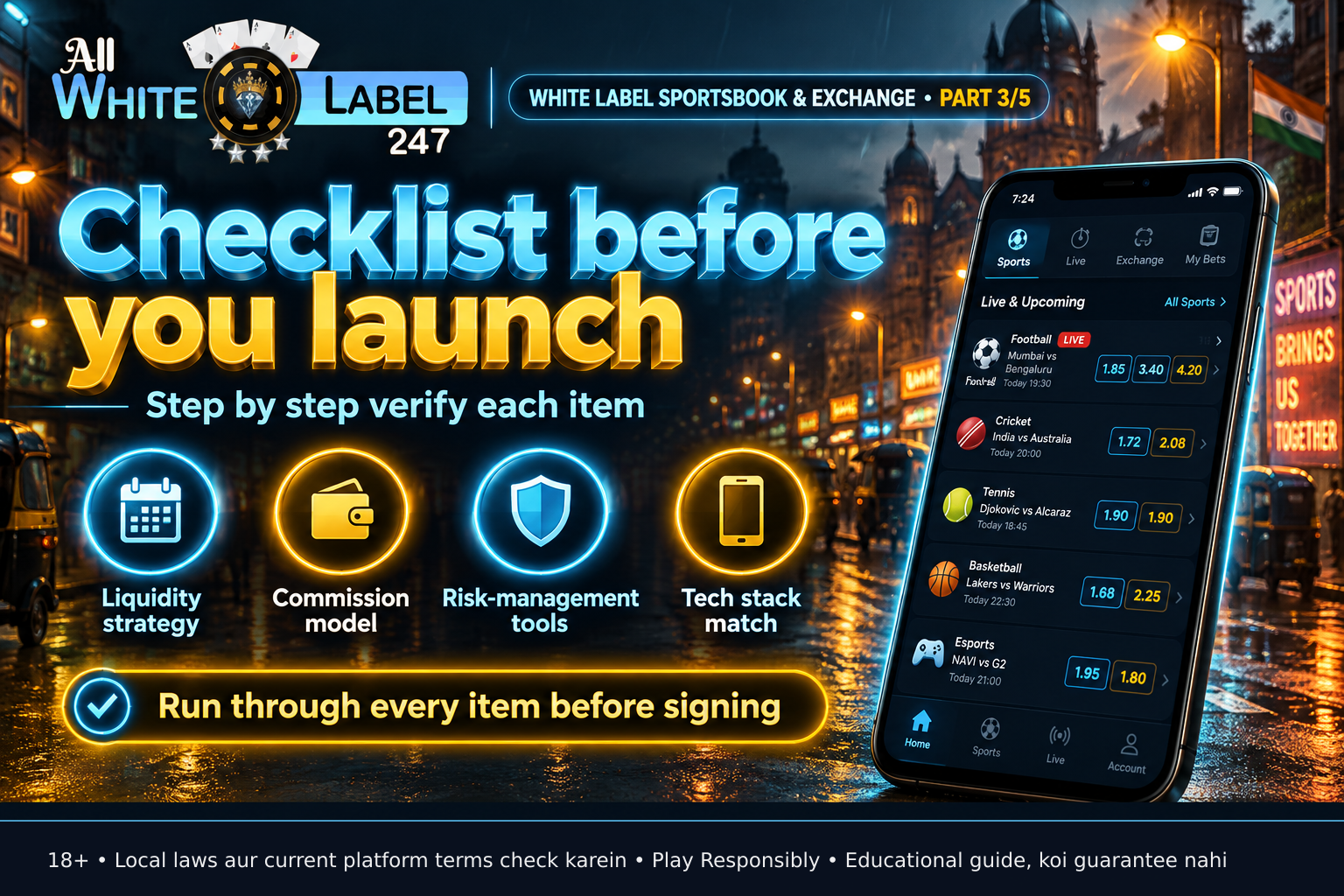
A turnkey white‑label package typically condenses steps 3‑5 into a 4‑week window. If you are building a custom exchange, add 3‑6 months for the matching engine development and an additional liquidity‑onboarding phase.
Questions to ask a white‑label provider
- What is the daily average matched volume included in the base licence fee?
- If our marketing campaign drives traffic 2× the included volume, what are the additional costs or required upgrades?
- Can the commission structure be customised (e.g., tiered rates based on monthly revenue)?
- What risk‑management tools are out of the box, and which require custom development?
- Does the package include a liquidity bridge, or will we need to integrate one ourselves?
- What is the typical timeline from compliance submission to "soft launch"?
- How are void‑or-suspended‑event settlements handled in the exchange model?
- What responsible‑gaming widgets are included, and can we brand them with our own UI?
Cost and timeline ranges (illustrative only)
White‑label sportsbook turnkey: ₹15‑30 lakh initial licence + ₹5‑10 lakh/month operational reserve. Time to live: 4‑8 weeks after compliance. White‑label betting exchange turnkey: ₹20‑40 lakh initial licence + ₹8‑15 lakh/month operational reserve (higher due to liquidity and matching‑engine overhead). Time to live: 4‑8 weeks for basic engine; additional 3‑6 months if self‑generated liquidity is required. Custom exchange build: ₹60‑1.2 crore development + ongoing hosting and liquidity‑bridge fees. Timeline: 6‑12 months from kick‑off to a liquidity‑healthy launch.
These are indicative ranges only. Your actual figures will depend on jurisdiction, transaction volume, the number of integrated payment methods, and the level of customisation you require. Always request a detailed cost breakdown from the vendor before signing.
Common mistakes to avoid
- Assuming the white‑label package includes liquidity. Most turnkey sportsbook deals do; exchange deals often do not. Ask the question up front.
- Overlooking the compliance timeline. KYC/AML approvals can take 6‑8 weeks on their own. Build that into your project plan or you will miss your marketing window.
- Choosing an exchange model without a liquidity strategy. If you launch with a thin order book, users will experience long wait times and may never return. Have a plan to generate or bridge liquidity before you go live.
- Treating commission as pure profit. Commission is revenue, but it is offset by support costs, chargebacks, regulatory fees and the cost of maintaining the platform. Model the net margin, not the gross.
- Ignoring responsible‑gaming obligations for exchanges. Limits on individual stakes, market‑void settlement rules and self‑exclusion mechanisms are not optional; they are part of the operator’s duty of care.
Quick checklist: what to verify before following this model
| What to check | Why it matters |
|---|---|
| Included daily matched volume (exchange) or overround structure (sportsbook) | Determines if your traffic will be absorbed at launch |
| Commission model: flat rate vs revenue share; gross vs net | Affects your actual take‑home margin |
| Risk‑management tools: stake limits, exposure caps, auto‑suspension | Protects you from imbalanced books and large win scenarios |
| Liquidity strategy: internal pool, bridge, or self‑generated | Decides user experience quality on an exchange |
| KYC/AML compliance requirements for your target jurisdiction | The single biggest delay in any launch |
| Responsible‑gaming widgets included and branding options | Ensures you meet regulatory and ethical duties |
| Payment‑method integration scope and settlement times | Affects user trust and cash‑flow |

Brand
AllWhiteLabel247 provides turnkey iGaming platform solutions for operators in India and South Asia. Whether you are launching a sportsbook, a betting exchange or a combined casino‑sports package, the team helps you select the right white‑label architecture, integrate payment rails and compliance tools, and launch within your target timeline. Specific licence costs, revenue share percentages and feature lists are detailed in the vendor contract you receive after an initial consultation—always verify those figures against the official regulator registry for your jurisdiction.
Call to action
If you are evaluating which white‑label model fits your next launch, start by mapping your liquidity capacity and compliance timeline against the checklist above; then request a detailed proposal from at least two providers so you can compare the true cost of ownership, not just the headline licence fee.
FAQ
- What is the difference between a white‑label sportsbook and a white‑label betting exchange? A sportsbook is a house‑based model where the operator sets odds and keeps the overround as profit. A betting exchange is a peer‑to‑peer marketplace where users back and lay outcomes against each other, and the platform takes a commission on net winnings. The exchange model shifts risk to players but requires deep liquidity to match bets quickly.
- How much liquidity do I need to launch a betting exchange? The amount depends on your target market and event coverage. A minimum of ₹1‑2 crore in available back‑and‑lay funds across major sports is a common starting point for a functional order book, but you should model your expected traffic and ask the vendor what average daily matched volume is included in the package.
- Can I run both a sportsbook and an exchange under one white‑label licence? Some vendors offer a combined package that includes both a fixed‑odds sportsbook and a matching engine, allowing you to operate both models from a single control panel. Confirm whether the commission structures and risk‑management settings can be configured independently for each model.
- What commission rate is typical for a white‑label exchange? Most white‑label exchange packages quote a commission of 2‑5% of net winnings. Some contracts offer tiered reductions once monthly revenue crosses specified thresholds; others charge a flat fee per market settled. Always read the contract to see whether the rate is applied gross or net of taxes and refunds.
- **How long does it take to go from contract to## FAQ
- What is the difference between a white-label sportsbook and a white-label betting exchange? A sportsbook is a house-based model where the operator sets odds and keeps the overround as profit. A betting exchange is a peer-to-peer marketplace where users back and lay outcomes against each other, and the platform takes a commission on net winnings. The exchange model shifts risk to players but requires deep liquidity to match bets quickly.
- How much liquidity do I need to launch a betting exchange? The amount depends on your target market and event coverage. A minimum of ₹1‑2 crore in available back-and-lay funds across major sports is a common starting point for a functional order book, but you should model your expected traffic and ask the vendor what average daily matched volume is included in the package.
- Can I run both a sportsbook and an exchange under one white-label licence? Some vendors offer a combined package that includes both a fixed-odds sportsbook and a matching engine, allowing you to operate both models from a single control panel. Confirm whether the commission structures and risk-management settings can be configured independently for each model.
- What commission rate is typical for a white-label exchange? Most white-label exchange packages quote a commission of 2‑5% of net winnings. Some contracts offer tiered reductions once monthly revenue crosses specified thresholds; others charge a flat fee per market settled. Always read the contract to see whether the rate is applied gross or net of taxes and refunds.
- How long does it take to go from contract to live operation? A turnkey sportsbook package typically takes 4‑8 weeks after KYC/AML compliance is approved. A basic exchange engine can go live in the same window, but building self-generated liquidity or integrating a bridge may add 3‑6 months. Always request a detailed timeline from the vendor that includes compliance, payment integration and QA phases.
- What responsible-gaming tools must I build for an exchange model? You need deposit limits, loss limits, self-exclusion timers and reality‑check pop‑ups as standard. Additionally, consider allowing users to set maximum back/lay stakes per market and have clear rules for how open positions are settled if an event is suspended or cancelled.
- Do I need a separate licence for a betting exchange versus a sportsbook? Licensing requirements vary by jurisdiction. Some regulators treat exchanges as a distinct product category, while others issue a single bookmaking licence that covers both fixed-odds and peer-to-peer betting. Consult your legal adviser and the local gambling commission to determine whether separate applications are needed.
- How are void or suspended-event settlements handled on an exchange? The platform’s rule book should define the settlement logic: typically, bets are refunded if the event does not occur, or markets are settled based on official results at the time of suspension. Ask the vendor to provide the exact settlement algorithm so you can communicate it to your users.
- Can I brand the responsible-gaming widgets included in the white-label package? Most vendors allow basic UI customisation (colours, logo placement) but do not allow full re‑writing of the interaction flow. Check the design guide early so you can plan your customer‑support scripts around the built‑in messages.
- What payment methods are typically integrated in a white-label package? Standard integrations include UPI, net-banking, major debit and credit cards, and popular e‑wallets. Some packages also offer crypto‑wallet options; confirm which methods are live in your target jurisdiction and whether additional integration work is required for regional preferences.
- How do I manage chargebacks and dispute resolution? The white-label contract should specify the chargeback window (often 30‑60 days) and the process for submitting evidence (transaction logs, KYC records). Build a support workflow that can respond within that window, and factor the potential financial impact into your reserve calculations.
- What are the typical ongoing operational costs after the initial licence fee? Ongoing costs include server hosting and bandwidth, KYC/AML service provider fees, payment‑gateway processing charges, support staff for peak hours, compliance audit fees and, for exchanges, any liquidity‑bridge or data‑feed fees. These vary widely based on transaction volume and jurisdiction; ask the vendor for a monthly cost model scaled to your projected handle.
- How do I monitor market integrity on an exchange without taking the opposite side of bets? Use position‑exposure dashboards that show the distribution of back and lay amounts across price levels. Set alerts for imbalanced books (e.g., 80% of volume on one side) and have a risk‑management team review daily. Some exchanges also employ market‑making bots to provide a minimum depth of liquidity.
- Is it possible to offer cash‑out functionality on a white-label exchange? Yes, many matching engines include a cash‑out feature that allows a user to settle a bet before the event concludes at a price derived from the current order book. Verify with the vendor whether this is a built-in option or requires custom development, and ensure your terms clearly explain how the price is calculated.
- What should I look for in a white-label vendor’s support SLA? Look for 24/7 technical support, a defined response time for critical issues (e.g., payment failures or matching-engine errors), and a dedicated account manager. For exchanges, also confirm that the SLA covers liquidity‑health monitoring and settlement‑dispute resolution.
18+ and responsible play
18+. Play responsibly. Decide your budget before you bet and never chase your losses. Check the current platform terms and local laws before participating. If you or someone you know has a gambling problem, seek help from a professional counselling service.