
Quick answer: Every iGaming white-label launch must include four core responsible gaming tools—deposit limits, cool-off periods, self-exclusion and reality checks—because regulators require them and they reduce chargebacks and regulatory scrutiny. While setup costs range from a few thousand dollars for a basic integration to six figures for a fully customised suite, the business protection they offer far exceeds the investment. This guide walks the decision you face when choosing a platform: compare the options, budget for the compliance work, and implement the tools before day one.
Key takeaways
- Deposit limits, cool-off periods, self-exclusion and reality checks are the four non-negotiable responsible gaming tools for any white-label iGaming operation.
- The decision you face is whether to buy a turnkey compliance module or build a custom integration; costs and timelines vary widely based on that choice.
- These tools protect the business as much as the player: they lower chargebacks, demonstrate due diligence to licences and keep retention steady by signalling trust.
- Every licensing or legal point must be verified with the regulator; no figure or claim about legal status should appear in this article without that source.
- End with a single call to action: review your current toolset against the checklist in this guide and update before your next marketing push.
What it is and why it matters
You are launching a white-label casino, sportsbook or exchange. The technology is ready, the payment gateway is integrated and the marketing plan is set. One piece is still missing: the responsible gaming toolkit. This is not a "nice to have" feature or a marketing add-on. It is a regulatory requirement in every jurisdiction that issues an online gambling licence, and it is a business safeguard that protects your bottom line.
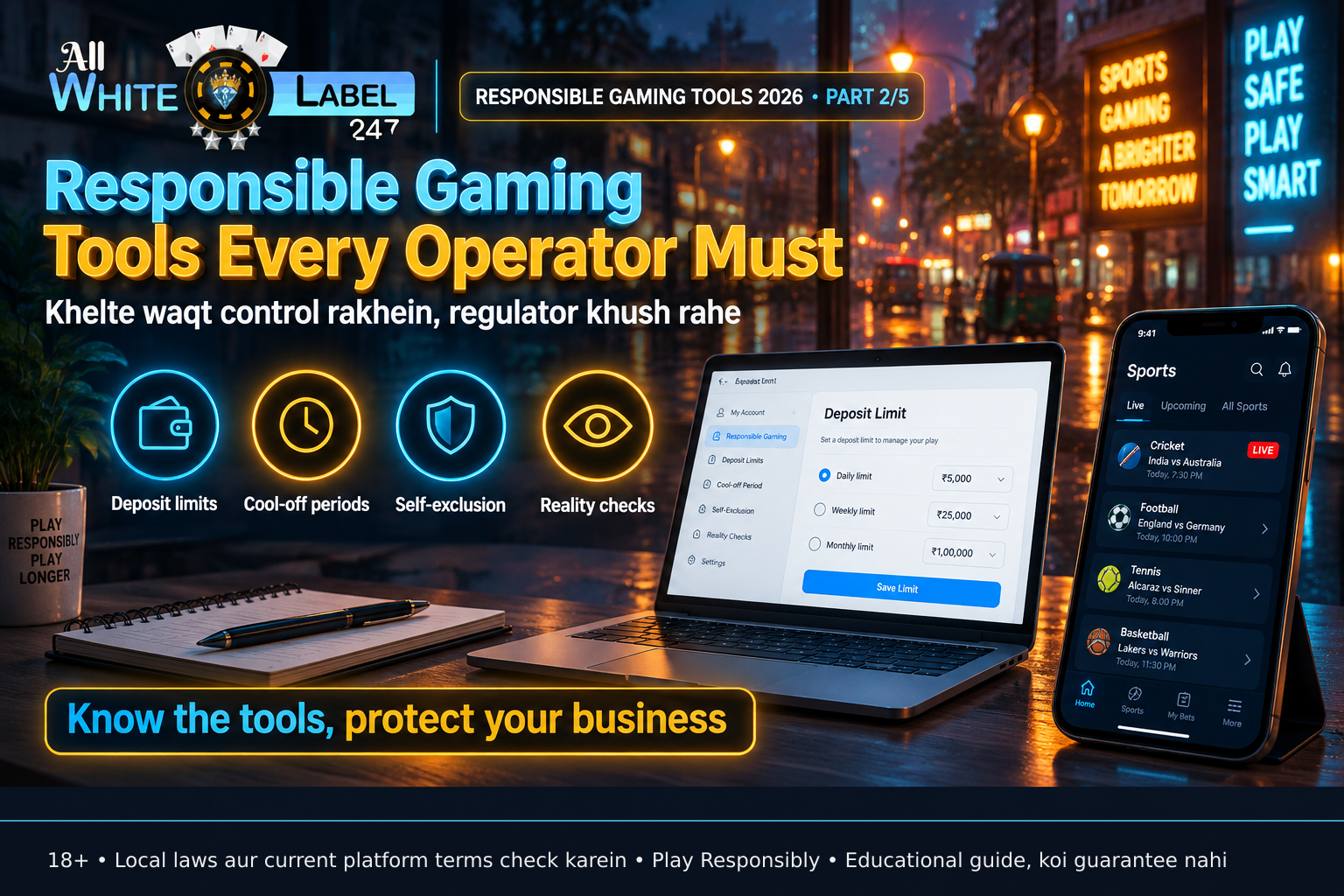
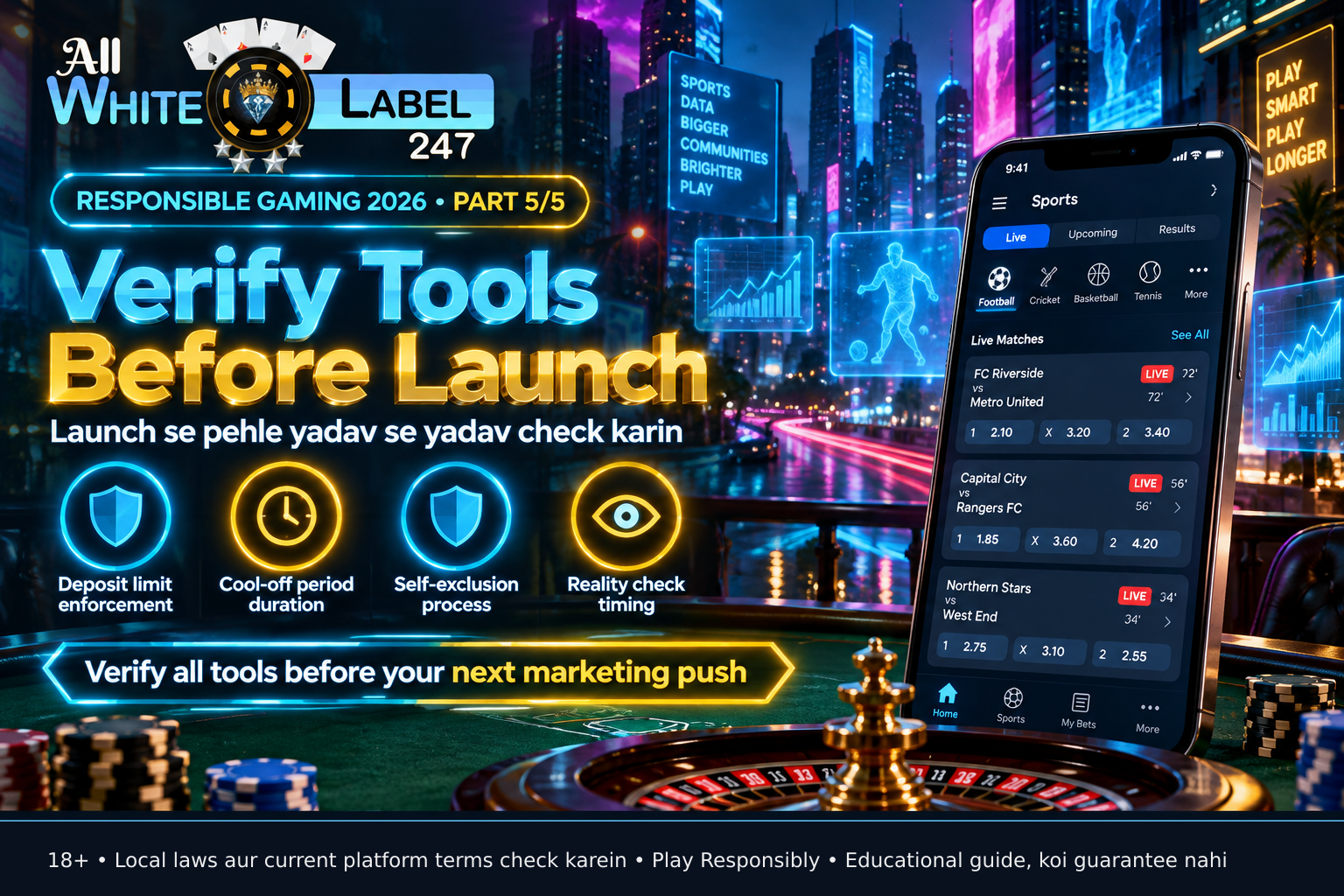
The four core tools—deposit limits, cool-off periods, self-exclusion and reality checks—are the minimum a platform must offer from the moment it goes live. Each one serves a different purpose, and each one sends a signal to regulators, payment processors and your own risk team that you are operating with due diligence.
- Deposit limits let a player cap the amount they can add to their account over a selected period (daily, weekly or monthly). For the operator, this is the first line of defence against uncontrolled spending and the chargebacks that follow.
- Cool-off periods (often called time-outs) are short self-imposed breaks, typically 24 hours to 30 days. They give a player a chance to step back without closing their account permanently.
- Self-exclusion is the formal, longer-term removal of a player from the platform, ranging from six months to several years. This is the tool invoked when a player’s gambling has become unmanageable.
- Reality checks are pop-up timers that show how long a session has been running, often with a balance update. They are designed to bring a player’s attention back to the time and money spent.
For the operator, these tools matter because they reduce the number of disputes that reach the chargeback stage, they demonstrate compliance during a licence audit, and they maintain a healthier player base by encouraging safer play. A player who can set a deposit limit is a player who stays longer, because they feel the platform respects their control.
The decision you face
When you are setting up a white-label iGaming platform, the decision about responsible gaming tools breaks down into two paths: turnkey compliance module or custom integration.
Turnkey compliance module
Most white-label providers bundle a basic responsible gaming suite as part of their standard offering. This usually includes deposit limits, cool-off periods and reality checks, with self-exclusion handled through a manual review process. The cost is typically included in the platform licence fee, which for a white-label casino can range from $10,000 to $50,000 per year depending on the jurisdiction and the number of games included. Implementation time is short—often two to four weeks—because the APIs are already documented and the user-interface screens are pre-built.
The limitation is customisation. You can often set the limits and the durations, but the wording of the pop-ups, the design of the self-exclusion request form and the integration with your specific CRM cannot be changed deeply. If your brand requires a unique player experience, you may find the turnkey module too rigid.
Custom integration
If you are running a sportsbook or exchange with bespoke features, or if you operate in a jurisdiction with strict responsible gaming mandates, a custom integration may be necessary. This involves working with your white-label provider’s development team or a third-party compliance vendor to build the exact tools you need, with the exact user flows and data logging requirements.
Costs here vary wildly. A basic custom set of deposit limits and reality checks might add $15,000 to $30,000 to the initial build. A full suite that includes self-exclusion workflows, AI-driven player monitoring and integration with national self-exclusion registers can push the development budget into six figures. Timelines are longer, typically three to six months from specification to launch, because each API call, each data privacy check and each regulatory report needs to be tested and signed off.
The business protection, however, is worth the investment. A custom toolset allows you to log every limit change, every cool-off request and every self-exclusion action in a format that satisfies regulators instantly. It also allows you to tie these events to your player‑lifecycle data, so you can see, for example, whether players who set a deposit limit have a higher lifetime value than those who do not.
Core checklist: what every operator must offer
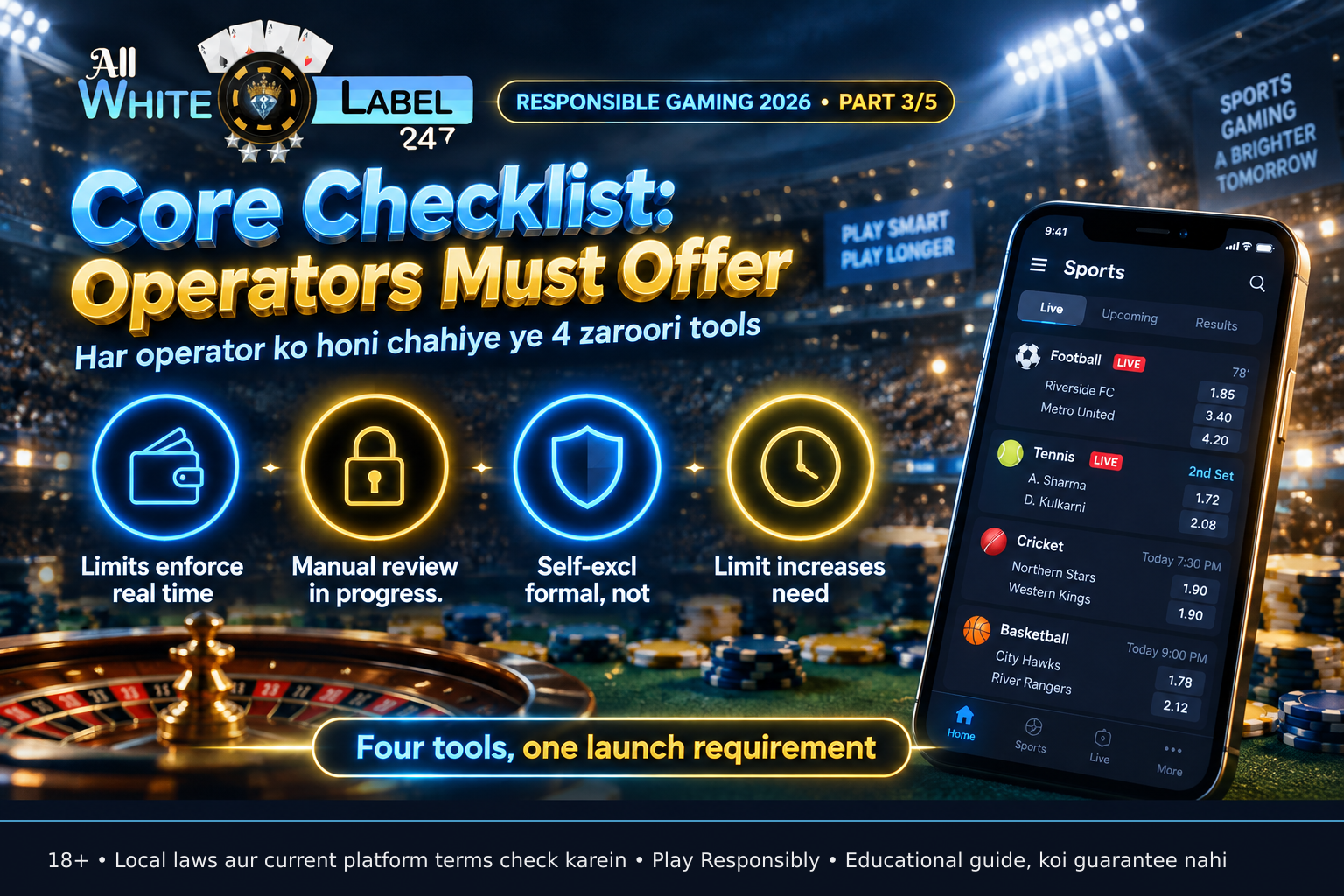
Whether you choose the turnkey module or the custom route, these four tools must be present and functional at launch.
- Deposit limits – The player must be able to set a daily, weekly or monthly cap on deposits. The platform must enforce the cap in real time and prevent any deposit that would exceed it. The limits should be easy for the player to change, but the change should not take effect immediately on a new high limit; a short cooling-off period (typically 24 hours) is the industry standard for limit increases.
- Cool-off periods – A player must be able to request a break of their choosing, from 24 hours up to 30 days. During the cool-off, the account is locked for new bets and deposits, but existing pending settlements are honoured. The player should be able to reactivate the account early only after a manual review, not by simply logging back in.
- Self-exclusion – This must be a formal process, not a button that logs the player out. The player fills a request, provides identification if required, and the account is closed for the selected period. The platform must report the exclusion to any national self-exclusion register it is connected to. After the period ends, the player must contact support to reactivate; auto‑reactivation is prohibited.
- Reality checks – A pop-up must appear after a set interval (commonly every 30 minutes or every hour of play) showing the duration of the current session and the net balance change. The player should be able to dismiss the pop-up, but it must be designed so it does not disappear instantly with a single tap—there should be a small delay or a “continue” button that requires a deliberate action.
Each of these tools is a data point. Every limit set, every cool-off requested and every self-exclusion action should be logged with a timestamp, the player ID and the type of tool used. This log is what you will produce during a licence audit, and it is what protects you if a player later claims the platform enabled irresponsible play.
Topic section: comparing tool options against risk and cost
The table below compares the four tools across two decision dimensions: implementation effort and player‑control depth. The rows represent the tool; the columns show what you can expect from a turnkey module versus a custom integration.
| Tool | Turnkey effort | Custom depth |
|---|---|---|
| Deposit limits | Set once in platform admin; player adjusts via profile; 24‑hour delay on increases. | Full API control; per‑currency limits; immediate changes with optional cooldown. |
| Cool-off periods | Pre‑defined durations (24h, 48h, 7d, 30d); player selects from list. | Player‑defined duration up to 90 days; automatic reactivation blocked; re‑entry requires support ticket. |
| Self-exclusion | Manual review form; exclusion sent to national register if connected; re‑activation after period ends. | Full workflow builder; integration with multiple registers; detailed audit logs per exclusion event. |
| Reality checks | Fixed interval pop‑up with session time and balance delta; one‑click dismiss. | Configurable interval; optional “reality check” screen with spend‑breakdown; mandatory wait before dismiss. |
The table makes it clear: a turnkey module gets you compliant quickly, but a custom build gives you the granular control that regulators prize and that your risk team will thank you for during an audit.
Device and account‑security section
Responsible gaming tools sit alongside basic account security. An operator must ensure that the tools themselves cannot be bypassed by a shared login or a compromised device.
- Verified web address: Always direct players to the official domain. Check that the URL begins with
https://and that the SSL certificate is current. A player who logs in via a fake mirror site will not see your responsible gaming tools, and the platform will have no record of the exclusion or limit setting. - Two‑factor authentication (2FA): Enable 2FA for all admin panels and for player accounts where the jurisdiction requires it. This prevents an unauthorised person from changing a player’s deposit limit or initiating a self-exclusion request.
- No shared OTP or PIN: Never design a flow where one player’s OTP can be used to access another’s responsible gaming settings. Each account must have its own verified contact channel.
- No unverified APK: If you offer a mobile app, it must be distributed only through the Apple App Store or Google Play Store, or via a verified direct download from your domain. Sideloaded APKs bypass the security controls that make responsible gaming enforcement possible.
The common mistakes to avoid
Many operators treat responsible gaming tools as a compliance checkbox and then ignore them until a problem arises. The following mistakes undermine the very purpose of the tools and expose the business to risk.
- Setting limits too high: If you set default deposit limits that are higher than the jurisdictional recommendation, players will ignore them, and regulators will note the misalignment during an audit.
- Making cool‑off reactivation too easy: If a player can exit a cool-off period by simply logging out and back in, the tool is useless. A manual review step is mandatory.
- Ignoring the self-exclusion register: If your jurisdiction has a national self‑exclusion register, every exclusion request must be reported. Failure to do so is a regulatory breach.
- Reality checks that can be dismissed without looking: If the pop‑up disappears the moment the player taps anywhere on the screen, the mechanism fails. Design the dismiss action to require a deliberate button press.
- Treating the tools as a marketing feature: Do not promote the existence of deposit limits or reality checks as a "feature" in bonus terms or advertisement copy. State them as operational facts, and keep the language plain: "You can set a deposit limit in your account settings."
Quick pre-session checklist
The table below is a status list you can run through before any player‑facing session goes live. Each row is an action; the "status" column is for you to tick off once verified.
| Action | Status |
|---|---|
| Deposit limits are configured for daily, weekly and monthly caps. | ☐ |
| Cool-off period options (24h, 48h, 7d, 30d) are active in the player profile. | ☐ |
| Self‑exclusion request form is live and linked to the national register, if applicable. | ☐ |
| Reality‑check interval is set and the pop‑up appears after the configured time. | ☐ |
| 2FA is enabled on all admin accounts and on player accounts where required. | ☐ |
SSL certificate is valid and the domain URL uses https://. |
☐ |
| Player‑facing terms mention the four tools and how to access them. | ☐ |
Brand section
AllWhiteLabel247 provides a white‑label iGaming platform that includes the four core responsible gaming tools described above as part of the standard module. The deposit limits, cool-off periods and reality checks are configurable in the admin dashboard, and the self‑exclusion workflow can be enabled with a single toggle. If you require a custom integration—such as integration with a specific national self‑exclusion register or AI‑driven player‑monitoring—additional development costs apply, and you should discuss the timeline with your account manager. All licensing and legal compliance points, including responsible gaming mandates, must be verified with the regulator in the jurisdiction where you intend to operate. Subject to terms.
Call to action
Review your current toolset against the checklist in this guide and update before your next marketing push.
FAQ
Q: Do we need all four tools from day one, or can we roll them out over time? A: Regulators in most jurisdictions require the full suite at launch. Rolling them out later can trigger a compliance review and may result in fines or a suspension of marketing activities. Build the tools into the initial scope, even if you start with the turnkey module and customise later.
Q: Can a player increase their deposit limit immediately? A: No. The industry standard—and the practice that satisfies most regulators—is to require a 24‑hour cooling‑off period before a new, higher limit takes effect. This gives the player a chance to reconsider and gives the operator a chance to review the change.
Q: What happens if a player self‑excludes and then wants to return after the period ends? A: The player must contact customer support and go through a manual reactivation process. The account is not auto‑reactivated, and the support team will verify that the self‑exclusion period has fully elapsed before restoring access.
Q: Are we required to report self‑exclusions to a national register? A: This depends on the jurisdiction. Some countries and states operate a central self‑exclusion register that all licensed operators must feed into. Check with your regulator whether your licence includes this obligation, and if it does, ensure the API integration is tested before go‑live.
Q: How do reality checks affect the player experience? Will they annoy our users? A: Reality checks are designed to be unobtrusive but impossible to miss. Most players adapt within a few sessions, and data from operators who have implemented them shows no drop in retention. The key is the interval: too frequent and players find them nagging; too infrequent and they lose their purpose. A 30‑minute or 1‑hour interval is the most common starting point.
Q: What is the cost of adding responsible gaming tools to a white‑label platform? A: If you use the provider’s turnkey module, the cost is typically bundled into the annual platform licence fee, which ranges from $10,000 to $50,000 per year depending on the jurisdiction and game count. A custom integration adds $15,000 to $30,000 for a basic set and can reach six figures for a full suite with AI monitoring and multi‑register integration. Timelines range from two to four weeks for turnkey and three to six months for custom builds.
Q: Do we need a separate licence for responsible gaming compliance? A: No. Responsible gaming tools are a condition of the operating licence you already hold. However, failing to implement them or failing to report self‑exclusions to a national register (if required) is a breach of that licence and can lead to penalties, fines or suspension.
Q: Can we promote the fact that we have deposit limits in our advertising? A: You may state that deposit limits are available as a player‑safety feature, but do not frame them as a bonus or a promotional benefit. Keep the language factual: "Players can set a daily deposit limit in their account settings." Avoid phrases like "limit your spending and claim a bonus" — that crosses the line from responsible gaming into promotional promise.
Q: What should we do if a player claims they were not aware of the cool‑off period feature? A: The user interface must make the feature visible and the terms must explain it clearly during account onboarding. If a player genuinely did not see the option, the support team should document the interaction, reset any pending cool‑off if appropriate, and reinforce the feature during the next login. The important thing is that the tool is accessible, not hidden.
Q: How do we handle a self‑exclusion request from a player who is underage? A: The platform must have strict age‑verification checks in place before any responsible gaming tool can be activated. If a player is identified as underage, the account should be terminated immediately and the matter reported to the regulator, rather than processed through the self‑exclusion flow.
Q: Is there a limit on how many times a player can set or change a deposit limit? A: Most platforms allow a player to change their limit a fixed number of times per period (for example, once per month), after which a mandatory cooling‑off period applies. Check your white‑label provider’s admin settings for the exact limit, and ensure the terms reflect this rule.
Q: Do reality checks apply to sports betting as well as casino games? A: Yes. Any real‑money session—whether on a slot, a table game, or a live sports bet—should trigger the reality check after the configured play time. The mechanism is the same; only the displayed data (session duration and net balance) changes based on the product type.
Q: What records must we keep for audit purposes? A: You must keep a timestamped log of every deposit‑limit change, every cool‑off request, every self‑exclusion action and every reality‑check trigger. The log should include the player ID, the type of tool used, the date and time, and the new setting or status. This log is the primary evidence you will present during a licence audit.
Final takeaway
Responsible gaming tools are not a separate add‑on to your white‑label platform; they are part of the foundational build. Deposit limits, cool‑off periods, self‑exclusion and reality checks protect your players, yes, but they also protect your licence, your payment relationships and your reputation. Choose the implementation path that fits your brand’s complexity—turnkey for a fast launch, custom for a bespoke experience—but make sure all four are live and fully functional before you open your doors to the first player.
Related reading
- Fraud and bonus abuse on iGaming platforms: a launch and risk‑operator’s playbook (allwhitelabel247.io)
- Saudi Pro League: Clubs, Rules & The AFC Champions League Route (allwhitelabel247.io)
- Ranji Trophy for Beginners: How a 4-Day First-Class Match Actually Works (allwhitelabel247.io)
- 2026 UEFA Europa League Format Explained – How Clubs Qualify, League Phase and Path to the Final (allwhitelabel247.io)