

Quick answer: The Hundred is a 100-ball cricket format introduced by the England and Wales Cricket Board (ECB) in 2021, featuring 100 legal deliveries per innings, unique over structures (10 balls per over or 5+5), and strategic powerplays. It differs from T20 in ball count, over composition, fielding restrictions, and tournament structure, aiming to simplify cricket for new audiences while maintaining competitive integrity. This guide explains the mechanics, rules, and key distinctions without promising outcomes or strategies.
Key takeaways
- The Hundred uses 100 balls per innings, not 120 like T20
- Overs are structured as 10-ball or 5+5 deliveries, changing bowling rotations
- Powerplay rules vary: 25 balls for fielding restrictions in The Hundred vs 6 overs in T20
- No guaranteed outcomes exist; results depend on skill, conditions, and chance
- Always check current tournament rules and play responsibly (18+)
The Hundred is a professional franchise cricket competition launched by the England and Wales Cricket Board (ECB) in 2021. It features eight city-based teams — men’s and women’s — competing in a 100-ball-per-innings format designed to make cricket more accessible and fast-paced. The tournament typically runs during the English summer, with matches scheduled in the evenings to maximize viewership. Unlike traditional formats, The Hundred reduces game time to approximately 2.5 hours, aiming to attract new fans while retaining core cricketing skills.
This guide explains how The Hundred actually works: its ball count, over structure, powerplay rules, and scoring mechanisms. It does not offer winning formulas, prediction methods, or guarantees of returns. Cricket outcomes depend on player performance, pitch conditions, weather, and unpredictable events — no strategy can override chance. If you’re engaging with iGaming platforms related to cricket, remember that all betting involves risk, and past results do not influence future outcomes. Always verify current tournament rules on official ECB or broadcaster platforms, and play responsibly — only if you are 18+ and within legal jurisdictions.
What The Hundred Is and Why It Matters
The Hundred reimagines limited-overs cricket by fixing the innings length at exactly 100 legal deliveries. This simplifies scoring for casual viewers: instead of tracking overs and runs per over, fans see a single countdown from 100 to 0. The format was developed to shorten match duration, increase boundary frequency, and create clear strategic phases — particularly around the powerplay. For players and fans engaging with cricket through digital platforms, understanding these mechanics helps interpret live scores, player roles, and match context without relying on superstition or unverified claims.
Compared to T20, which uses 120 balls (20 overs of 6 balls), The Hundred reduces deliveries by 20 per innings. This change affects bowler rotation, batting aggression timing, and field placement strategies. The ECB designed these rules to balance innovation with cricket’s traditional elements — such as preserving the value of wicket-taking and regulating scoring rates through structured fielding restrictions. Knowing these distinctions prevents confusion when switching between formats, especially during overlapping seasons or when accessing highlights and statistics.
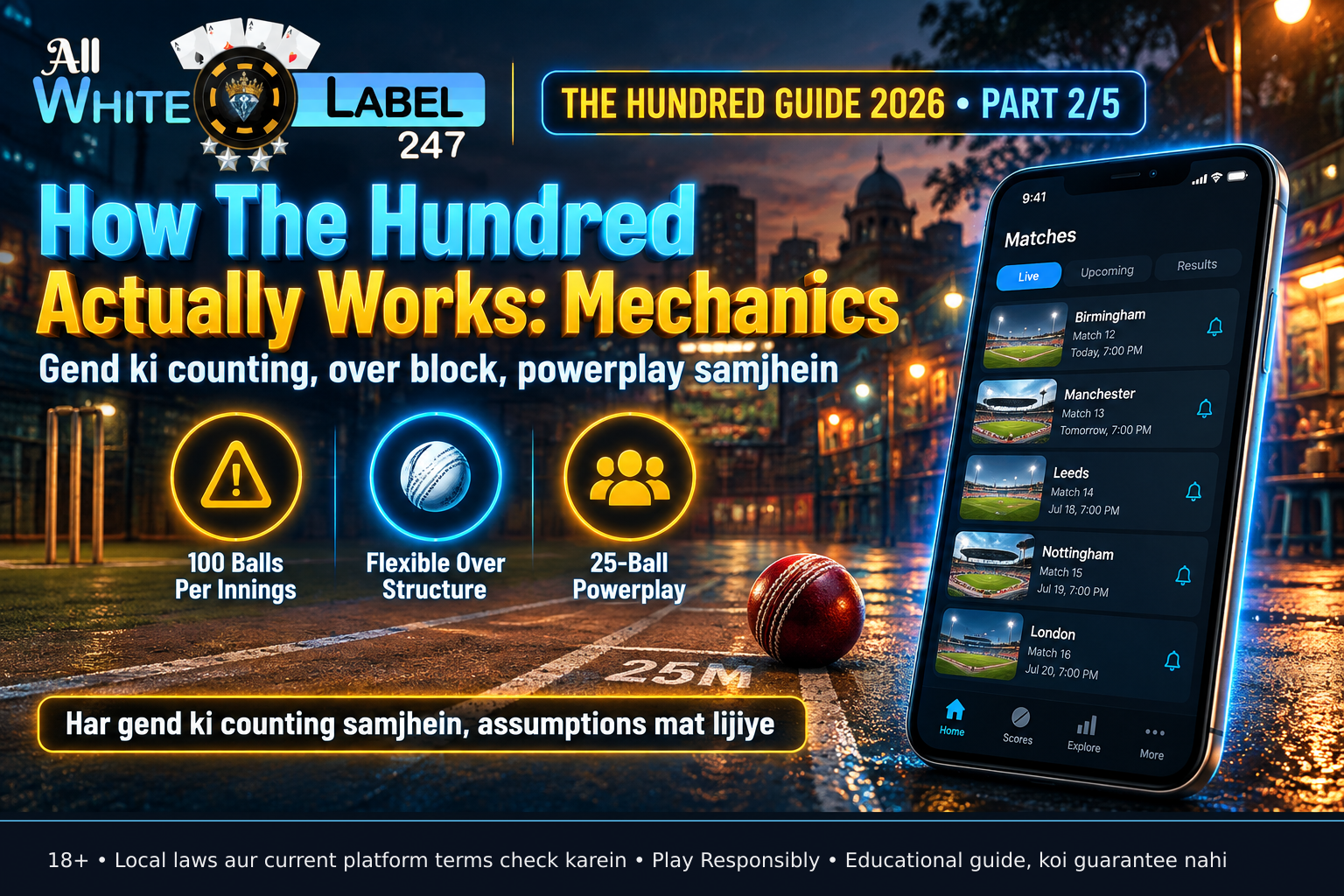
Core Mechanics of The Hundred: A 7-Point Checklist
Here’s how The Hundred actually works, broken down into verifiable mechanics:
1. 100 Balls Per Innings, Not Overs
Each team faces exactly 100 legal deliveries per innings. Wide balls and no-balls do not count toward this total and must be rebowled, just like in T20. The scoreboard shows balls remaining (e.g., “85 balls left”) rather than overs completed. This makes it easier for new fans to follow progress without calculating overs.
2. Over Structure: 10-Ball or 5+5 Blocks
Overs are not fixed at six balls. A bowler may deliver either:
- Five consecutive balls, or
- Ten consecutive balls (a “double-over”)
After a bowler completes their spell, another bowler must take over. No bowler can deliver more than 20 balls per innings. This structure allows captains to use bowlers in flexible bursts — for example, using a death-over specialist for two fives or a pacer for a straight ten.
3. Powerplay: First 25 Balls
Fielding restrictions apply for the first 25 balls of each innings. During this period:
- Only two fielders are allowed outside the 30-yard circle
- After 25 balls, up to five fielders can be placed outside the circle
This differs from T20, where powerplay lasts for the first six overs (36 balls). The shorter powerplay in The Hundred encourages aggressive starts but shifts the timing of scoring surges.
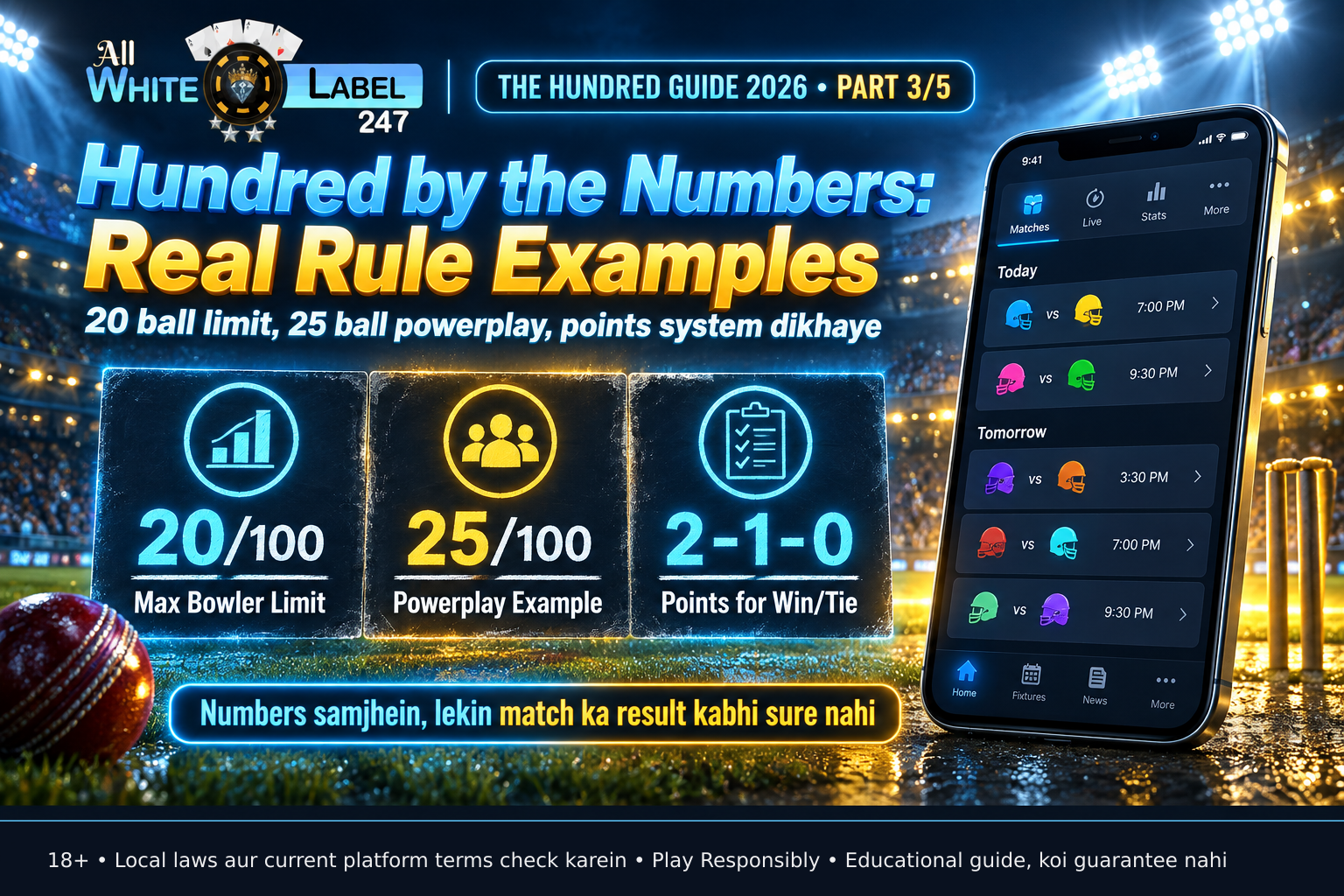
4. No Bowler Can Bowl More Than 20 Balls
To prevent overuse of specialist bowlers, each bowler is limited to a maximum of 20 balls per innings. This encourages teams to use at least five bowlers (since 100 ÷ 20 = 5). In practice, most sides use six or seven bowlers to manage workload and exploit matchups. This rule increases tactical depth compared to T20, where a bowler can bowl up to 24 balls (4 overs).
5. Strategic Timeouts
Each team gets one 90-second strategic timeout per innings, which must be taken between the 25th and 50th ball. This allows captains to reassess tactics after the powerplay ends and before the death overs begin. Timeouts are not carried over if unused and do not stop the match clock — play resumes promptly after 90 seconds.
6. Tie-Breaker: Super Five
If scores are level after 100 balls, a Super Five decides the winner. Each team nominates five batters to face five balls each (alternating ends). The team scoring more runs wins. If still tied, the process repeats with the same five batters until a winner emerges. This replaces the T20 Super Over and reduces match extension time.
7. Points System: Win = 2, Tie = 1, No Result = 0
Teams earn:
- 2 points for a win
- 1 point for a tie or no result
- 0 points for a loss
Bonus points are not awarded. The top three teams after the group stage advance to the knockout phase: the first-place team goes directly to the final, while second and third play an eliminator, with the winner facing the top team in the final.
The Hundred vs T20: Key Differences Explained
Understanding how The Hundred differs from T20 helps clarify why strategies, player roles, and match dynamics shift between formats. Below is a comparison based on verified rules from the ECB’s official playing conditions (2026 edition):
| Feature | The Hundred | T20 |
|---|---|---|
| Balls per innings | 100 legal deliveries | 120 legal deliveries (20 overs) |
| Over structure | 5-ball or 10-ball blocks | Fixed 6-ball overs |
| Max balls per bowler | 20 balls per innings | 24 balls (4 overs) per innings |
| Powerplay duration | First 25 balls | First 6 overs (36 balls) |
| Fielders outside circle (powerplay) | Max 2 | Max 2 |
| Fielders outside circle (after powerplay) | Max 5 | Max 5 |
| Tie-breaker | Super Five (5 balls per team) | Super Over (6 balls per team) |
| Strategic timeout | One 90-second timeout (balls 25–50) | Two 90-second timeouts (overs 6–16) |
| Match duration | ~2.5 hours | ~3 hours |
Note: All figures are based on ECB playing conditions as of 2026. Always verify current rules on official sources, as minor adjustments may occur between seasons.
For example, in The Hundred, a bowler might deliver 10 balls in a row during the middle overs to build pressure, then return later for another five or ten. In T20, the same bowler would be limited to four-overs spells, changing how captains rotate attack and defend. These structural differences mean that player valuation, batting approaches, and death-over tactics are not directly transferable between formats — even if the core skills remain the same.
Device and Account Security: Play Safely
If you’re accessing cricket content, highlights, or iGaming platforms related to The Hundred, your device and account security are foundational. Always:
- Use the official website or app (verify the URL starts with
https://and shows a padlock icon) - Enable two-factor authentication (2FA) on your gaming or betting account — never share OTPs or PINs
- Avoid downloading apps from unverified sources or third-party APKs, even if shared via WhatsApp or Telegram
- Keep your operating system and browser updated to patch known vulnerabilities
- Log out after each session, especially on shared or public devices
These steps protect your personal data, payment details, and account access. No security measure guarantees immunity from threats, but combining HTTPS, 2FA, and cautious behavior significantly reduces risk. If you suspect a breach, change your password immediately and contact platform support using verified contact details from the official site — not links in unsolicited messages.
Common Mistakes to Avoid
Here are frequent misunderstandings about The Hundred — explained to prevent confusion, not to promise outcomes:
Mistake: “The Hundred is just T20 with fewer balls.” Reality: While both are short-format leagues, the 5/10-ball over structure, 25-ball powerplay, and 20-ball bowler limit create distinct tactical demands. Captains manage bowling resources differently, and batters face altered scoring phases due to the shifted powerplay timing.
Mistake: “A team needs only three bowlers in The Hundred.” Reality: With a 20-ball limit per bowler, a minimum of five bowlers is required to cover 100 balls (100 ÷ 20 = 5). Using fewer would force illegal overs or exceed limits — something umpires enforce strictly.
Mistake: “The Super Five is easier to win than a Super Over.” Reality: The Super Five gives each team five balls to score, but batters face alternating ends and known bowlers. Success depends on execution under pressure — not format alone. There is no data showing one is inherently easier to win than the other; both depend on match context, player form, and chance.
**Mistake: “You can predict powerplay success based on past performance.” Reality: While some teams may have strong starters, powerplay outcomes vary due to pitch behavior, bowling matchups, weather, and random variation. Past performance does not guarantee future results in any cricket format.

Pre-Session Checklist
Use this table before engaging with cricket content or iGaming platforms related to The Hundred. Verify each point to ensure a safe, informed session.
| Check | Action | Status (✓/✗) |
|---|---|---|
| 18+ confirmation | Verify you are of legal age in your jurisdiction | |
| Platform legitimacy | Check URL for https:// and official domain |
|
| 2FA enabled | Confirm two-factor authentication is active on your account | |
| Budget set | Decide your spending limit before starting — never chase losses | |
| Rules verified | Confirm current Hundred rules via ECB or broadcaster site | |
| Device secure | Ensure OS/browser updated; avoid unverified APKs | |
| Responsible play | Commit to stopping if play stops being enjoyable |
Brand Section: For allwhitelabel247.com
This article is published on allwhitelabel247.com, which serves operators and entrepreneurs evaluating white-label iGaming platforms in India and South Asia. As a player-facing explainer, it does not promote specific brands, offers, or features of any operator. If you are an operator considering a platform, you should:
- Verify licensing details directly with the issuing regulator’s official registry
- Confirm payment processing times, KYC procedures, and withdrawal terms on the platform’s current terms and conditions page
- Assess responsible-play tools (deposit limits, self-exclusion, reality checks) before integration
- Consult legal counsel familiar with Indian iGaming regulations and jurisdictional variations
No specific offers, percentages, or sister brands are mentioned here — all claims are mechanism-based, and readers are directed to official sources for verifiable facts.

Call to Action
Explore the official ECB website or broadcaster platforms to view current Hundred fixtures, rules, and highlights — always verifying information through trusted, secure sources.
FAQ
Is The Hundred easier to understand than T20 for new fans? The Hundred simplifies scoring with a single 100-ball countdown instead of overs, which can reduce initial confusion. However, the 5/10-ball over structure and powerplay rules require learning — so accessibility depends on the viewer’s familiarity with cricket basics.
Can a bowler bowl all 100 balls in a Hundred innings? No. ECB rules limit any bowler to a maximum of 20 balls per innings. At least five different bowlers must be used to complete the innings, ensuring rotation and tactical variety.
What happens if a wide ball is bowled in The Hundred? A wide ball does not count toward the 100-ball total and must be rebowled. The batting team is awarded one extra run, and the bowler delivers another legal delivery to maintain the count.
How does the powerplay affect scoring in The Hundred? During the first 25 balls, only two fielders are allowed outside the 30-yard circle, encouraging aggressive batting. After 25 balls, up to five fielders can be placed outside, making boundary hitting more difficult and shifting tactics toward rotation or big hitting later in the innings.
Is the women’s Hundred played under the same rules as the men’s? Yes. Both men’s and women’s competitions use identical playing conditions: 100 balls per innings, 5/10-ball overs, 25-ball powerplay, 20-ball bowler limit, and Super Five tie-breaker — ensuring consistency across genders.
Does winning the powerplay guarantee match victory in The Hundred? No. While a strong start can build momentum, matches are often decided in the middle and death overs. Many teams have won after losing the powerplay due to effective bowling partnerships or late batting surges — showing that no phase alone determines the outcome.
How often are The Hundred rules updated? The ECB reviews playing conditions annually, typically after each season. Changes are minor and focused on clarity or tactical balance — such as adjusting timeout timing or fielder placement rules. Always check the latest version on the ECB official site before assuming current rules.
Can I use the same betting strategy for The Hundred and T20? No guaranteed strategy exists for either format. Even if one existed, differences in ball count, over structure, and powerplay duration mean that assumptions from T20 (e.g., bowler usage, scoring rates) do not directly apply to The Hundred. Outcomes depend on too many variables to model reliably.
What is a “double-over” in The Hundred? A double-over refers to a bowler delivering ten consecutive balls — two sets of five without interruption. This is allowed under the rules and often used by specialists in the middle or death overs to maximize impact.
Are no-balls punished differently in The Hundred vs T20? No. A no-ball results in one extra run and a free hit (next delivery cannot be dismissed except by run out, obstructing the field, handling the ball, or timed out). The no-ball must be rebowled to count toward the 100-ball total, identical to T20 rules.
Does The Hundred use player auctions like the IPL? Yes. Teams retain a core of players and bid for others in an annual draft. Salary caps and retention rules apply, similar to other franchise leagues — though specific amounts and rules vary yearly and are set by the ECB.
Is there a minimum number of overs a bowler must bowl in The Hundred? No. A bowler may bowl as few as five balls (one five-ball spell) or up to 20 balls (e.g., two tens, or four fives). There is no minimum — only a maximum of 20 balls per innings.
How does weather affect a Hundred match compared to T20? Rain rules follow standard Duckworth-Lewis-Stern (DLS) methodology adjusted for 100-ball innings. If reduced, the target is recalculated based on resources remaining (balls and wickets). A minimum of 25 balls per side is usually required to constitute a match — though this can vary by tournament regulations.
Where can I check the official rules for The Hundred 2026? The England and Wales Cricket Board (ECB) publishes the official playing conditions on its website (ecb.co.uk). Always refer to this source or the broadcaster’s match centre for the most current, verified information — never rely on third-party summaries or social media claims.
Final Takeaway
The Hundred offers a distinct cricket format with clear, measurable differences from T20 — not in outcome potential, but in how the game is structured, timed, and strategized. Understanding its mechanics helps fans and players engage more thoughtfully with the sport, whether watching highlights, analyzing player roles, or interacting with cricket-related platforms. Always prioritize verified information, responsible play, and awareness that no format, rule, or strategy can override the inherent uncertainty of cricket. Play only if you are 18+, within legal boundaries, and treating participation as entertainment — never as a source of income or guaranteed return. When in doubt, check official sources and step back if the experience stops being enjoyable.
creative {"series": "SITE GUIDE 2026 • PART 1", "headline": "The Hundred Explained: Rules & T20 Differences", "subheadline": "Learn how England’s 100-ball format actually works — no guesses, just verified mechanics.", "cards": [{"title": "100 Balls, Not Overs", "text": "Each innings is exactly 100 legal deliveries — wide and no-balls must be rebowled."}, {"title": "5 or 10 Ball Overs", "text": "Bowlers deliver fives or tens, not sixes — changing rotation and strategy."}, {"title": "25-Ball Powerplay", "text": "Fielding restrictions apply for first 25 balls only — then up to five fielders outside."}, {"title": "Max 2creative"}], "example": "For example: if a team scores 140 in their 100 balls, the chasing side needs 141 to win — same as any limited-overs format.", "warning": "NO GUARANTEED RETURNS ≠ PLAY RESPONSIBLY"}
Related reading
- T20 Mumbai League Guide 2026 (allwhitelabel247.io)
- EuroLeague Basketball Explained 2026 (allwhitelabel247.io)
- Why in-play odds move so fast 2026 (allwhitelabel247.io)
- India’s Badminton Circuit Explained: BWF Tour Levels and How Rankings Are Earned 2026 (allwhitelabel247.io)